Superannuation: where does the money come from?
New Zealand Superannuation provides a married couple with $44,412 a year after tax. A single person living alone receives $28,868 a year net of tax. For some people, this will provide them with a lifestyle similar to what they had prior to retirement. If the lifestyle, however, they want in retirement cannot be funded by this, they will need to save the shortfall prior to retirement, win lotto or receive an inheritance. Of these, the only option they control is saving. That is, they need to give up some expenditure before retirement, to have money for expenditure in retirement.
If someone does not save today, should the government make them? The government might do this, for example, by making KiwiSaver compulsory, eg a 6% employee/6% employer contribution as some have suggested. Forced, legislated, savings. But what, if they do not need to save more or can’t afford to save more? Too bad, compulsion catches everyone.
Laws, by and large, fall into one of two categories. They are designed to stop someone doing something they want to do, or to make them do something they do not want to do. In some of those cases, it might be to clarify, give guidance and reinforce existing behaviours, but mostly it is to make people do things they are not doing. If they then still do not, they are breaking the law. Governments should think carefully about making individuals fall foul of the law when there is no mental or physical harm done to someone else or to someone else’s property.
If a person needs to save, the question is when and how much they should save for retirement, including into KiwiSaver or another retirement savings arrangement. Savings might also take the form of building up a business.
For most people, if they are disciplined, the logical time to start saving for retirement is when they have cleared debt; not when they start work. In fact, the optimal financial pathway when they start work will be to start saving for a deposit for a house, which might be through KiwiSaver. They then borrow money and buy a house and provide for their retirement by paying off the mortgage as fast as practicable. Once they have the mortgage cleared, they take the money they were paying to their mortgage and save all of it, or the amount needed, for their retirement. This path is likely to result in a better outcome financially than most alternatives. So compulsory KiwiSaver, not only would make a person do something that they did not want to do, for whatever reason, but also, it would make them do something that was less than financially optimal. Why would a government want to do that? Perhaps it is so they can ultimately means-test New Zealand Superannuation? If that is the end goal, it would be nice for them to be upfront and tell us.
But where do the increased savings come from to increase an individual’s KiwiSaver rate from 0% to 6% or 3.5% to 6%, depending on what they currently do. The money has to come from stopping them doing something else. And where does the employer’s contribution come from? Might it, in fact, come from reducing the employee’s future wages by reducing the increases the employer might otherwise have given?
To fund the increased savings, individuals will fall into four categories. Some are already saving 6% but just not in KiwiSaver. They will probably reallocate it from what they think is best for them to what the government thinks is best for them. They do not ‘win’ as they haven’t increased savings, but the fund managers win through increased fee income. No doubt a few more fund managers will start KiwiSaver schemes and so there will be a deadweight cost to the economy and reduced efficiencies of scale. These individuals will lose by the fees and restrictive nature of KiwiSaver.
Some will borrow to make the savings. In fact, this is what seems to have occurred in Australia when you look at the data. Most people will fall into this category if not in the first one, as they will now not pay off debt as quickly, particularly their mortgage, ie the savings will be funded through lower debt repayments. Most independent financial advisers rarely recommend that an investor borrows to invest and so this is not a good option unless the return from KiwiSaver after-tax and after-fees is greater than the interest rate being paid on the debt before-tax. And this takes no account of risk.
Then there will be a group who stop spending in some areas so they can afford to save the extra. For some this may be out of the money they would otherwise have spent on discretionary items, a holiday, an extra coffee, a movie, an electric car etc. For others it will be through less or cheaper food or less electricity for heating – the essentials of life. It is hard to see how New Zealand Inc benefits, if people can no longer afford the essentials in life. Also, for the people who fund it out of reduced discretionary spending, what is the impact on the small motel owner that relied on people coming for their holiday and the impact on the individual’s mental health who now does not get to unwind?
The fourth group are those who break the law and do not save.
Overall, most employees will not benefit by a compulsory KiwiSaver scheme, many will be worse off and will suffer considerable anxiety. But many fund managers and the wider financial services industry, including lawyers and accountants, will be better off.
There are also other considerations for New Zealand Inc. If people spend less because they now save more, GST receipts will go down, income tax on the businesses that would have received the expenditure will go down and government expenditure on welfare (food banks, accommodation supplements etc) will go up. Health costs may also rise as people eat less food or lower quality food or heat their homes less or defer essential maintenance. Does this mean more government debt? Or does it mean less healthcare, less education, less law and order and less infrastructure? Yes, the government might collect more tax from investment income, but this is subsidised as the top rate is limited to 28%, well below the top personal tax rate of 39% but it will get less tax from GST and non-PIE investment income. We may also see more businesses go under that relied on the expenditure to stay afloat. Of course, it could be that the government recovers the tax shortfall by means-testing New Zealand Superannuation! Again, it would be nice to know the long-term plan.
But what about the economic and investment implications? There is no free lunch here.
When a person invests, they make a claim on the future economic activity generated by the use of their capital. The return they receive ultimately depends on the ability of the economy to meet that claim; there are no guarantees. With the increased savings there will be increased future claims. If the New Zealand economy does not have genuine economic growth as a result, the same amount of the economic activity in any year allocated to compensate investors for the use of their savings, will simply be allocated among the greater claims. The result is that individuals, in aggregate, will get the same total return in dollar terms, but it will be a lower return as a percentage of their KiwiSaver account balances. Net to net, they will be worse off.
Of course, savers may choose to invest it in overseas markets, the most likely outcome, and recover some of the return otherwise lost but how does that benefit New Zealand Inc in the immediate future? It will lower our exchange rate, increase inflation from imported goods and probably result in higher interest rates, including higher mortgage rates. Not a good outcome for many individuals.
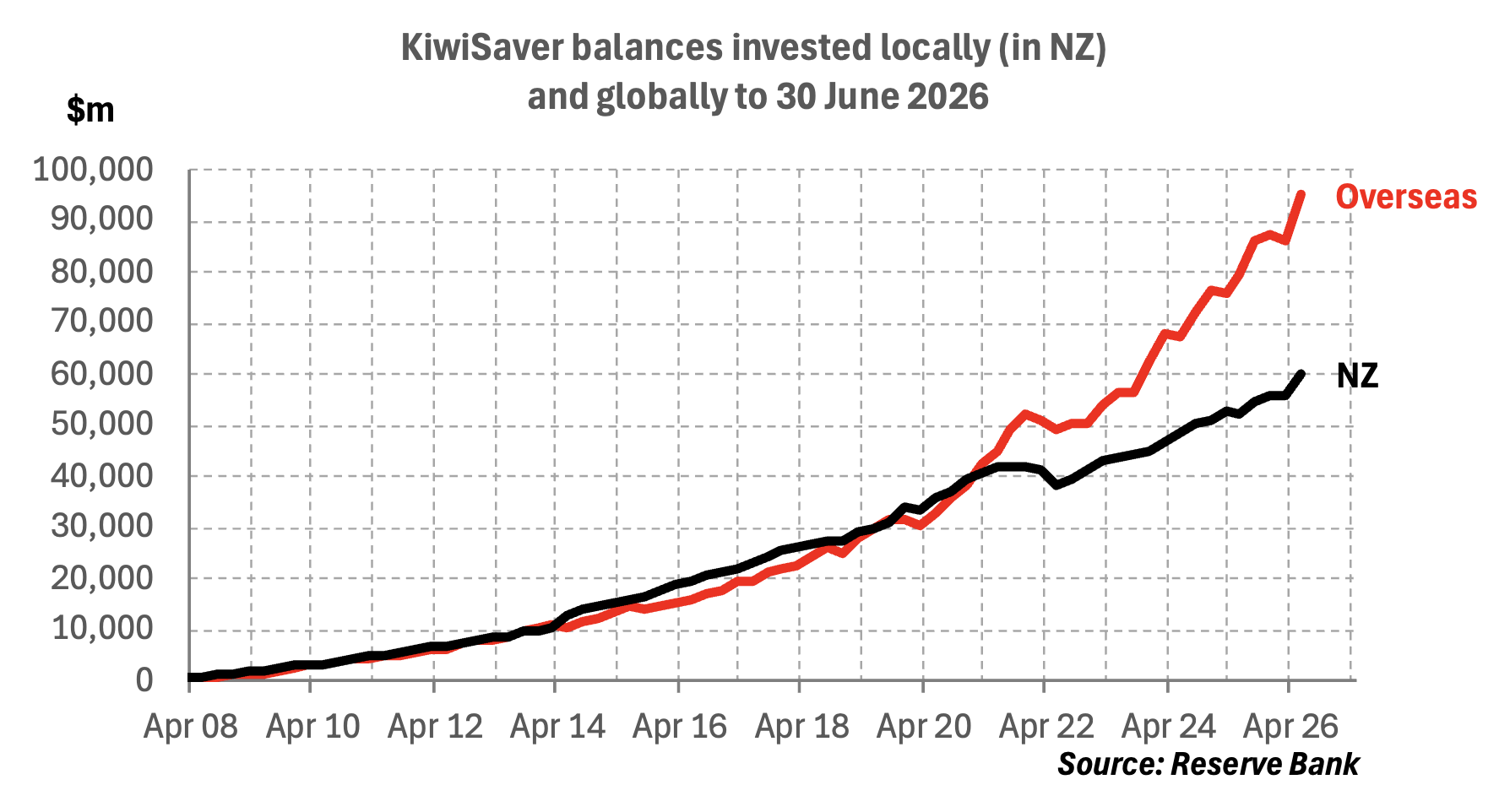
Of course, introducing compulsion assumes that it will increase the total level of savings. It might but as the data show, compulsion is more likely to change where people save and how much debt they take on, and not their overall financial position in retirement. This is what the current Australian data shows and can be read about here.
But the financial service providers will be the winners.